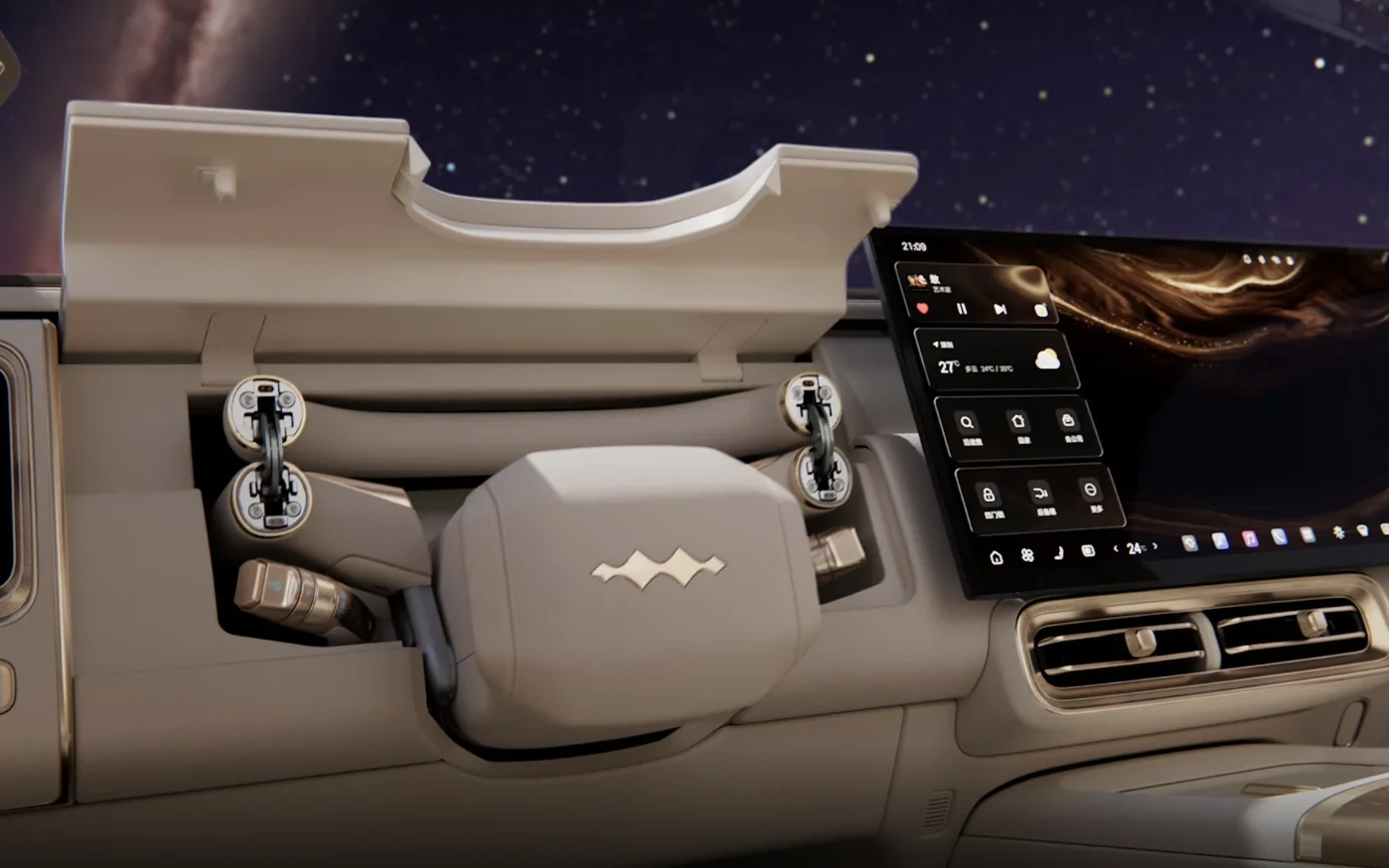
For about ten years, motor shows have featured a steering wheel that slides away so the “driver” can relax. It has never reached a showroom. Today it did, in China, on the top version of BYD’s Fang Cheng Bao Tai 9.
Press a button and the wheel swings through 180 degrees and disappears into the dashboard in about 10 seconds, freeing up the space in front of the driver. BYD says the hinges and motors that move it are derived from its robotics work. Deploy it again and you get an ordinary D-shaped wheel with physical buttons, not a yoke.
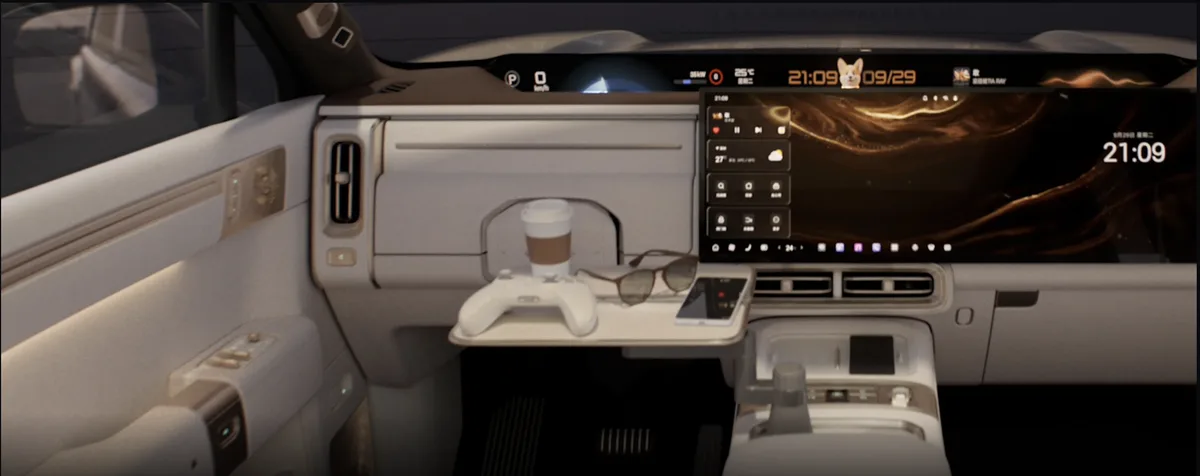 Wheel stowed: Fang Cheng Bao’s own images show a tray where it used to be. Image: Fang Cheng Bao
The trick is what’s missing
The wheel can fold because nothing connects it to the front wheels. The Tai 9 uses steer-by-wire: the wheel is an input device, and electric motors turn the road wheels. Take away the steering column and you can put the wheel wherever you like, including inside the dashboard.
Until recently, that was legal in China only with special approval. A new national standard that took effect on 1 July 2026 dropped the long-standing requirement for a mechanical link between the steering wheel and the road wheels, provided the system meets rules on backup and fail-safes. BYD has put it into a family SUV within five months.
The rest of the Tai 9
It’s the largest model yet from Fang Cheng Bao, BYD’s off-road-flavoured brand: 5.27 metres long, with six seats in three rows. A 1.5-litre turbo petrol engine works with two electric motors for 400kW (536hp), and BYD quotes 0–100km/h in 4.8 seconds. Its 66.48kWh Blade battery gives up to 310km (193 miles) of electric range on the WLTC test, and rear-wheel steering and lidar are standard.
Prices in China run from 279,900 to 329,900 yuan, roughly £31,800 to £37,500 at today’s rates. Only the top version has the folding wheel.
Gimmick or glimpse?
Today, it’s a lounge feature: with no self-driving system that lets you take your hands off for good, the space it frees is for a nap, a film or a takeaway while the car charges. In a market where buyers already choose cars for their fridges and massage seats (the Tai 9’s six seats are all heated, ventilated and massaging), that sells.
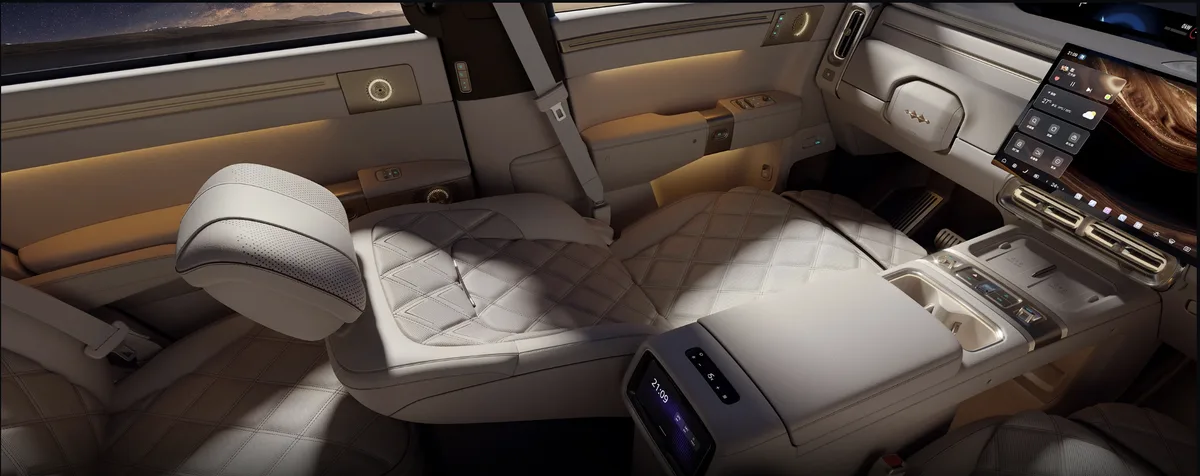 The pitch: park, fold, recline. Image: Fang Cheng Bao
The more important part is underneath. Steer-by-wire is a building block for cars that drive themselves, and for cabins that rearrange themselves when they do. China now allows it in ordinary cars; BYD has shown it can build it at family-SUV prices.
What does this mean for UK buyers?
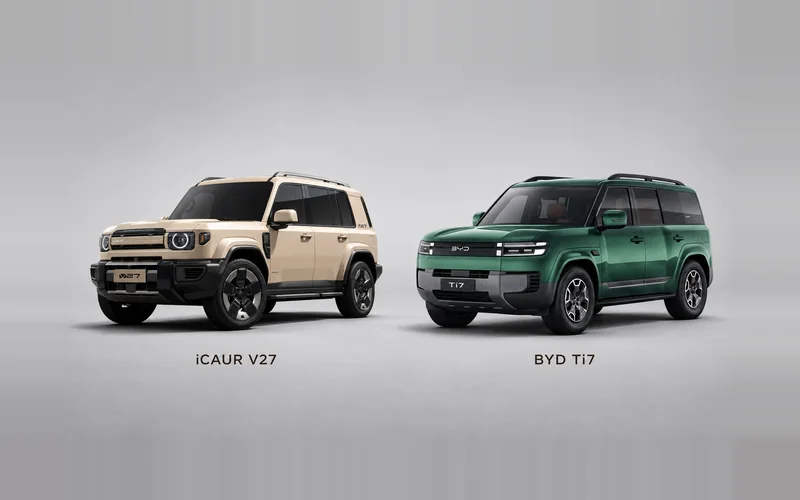
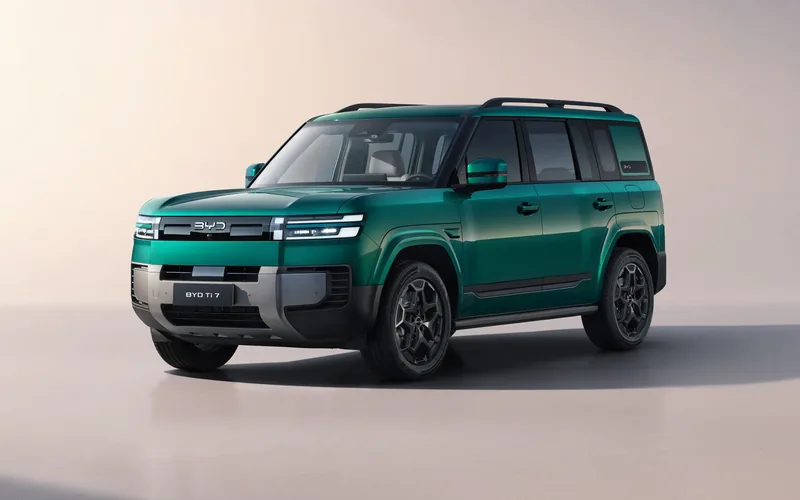
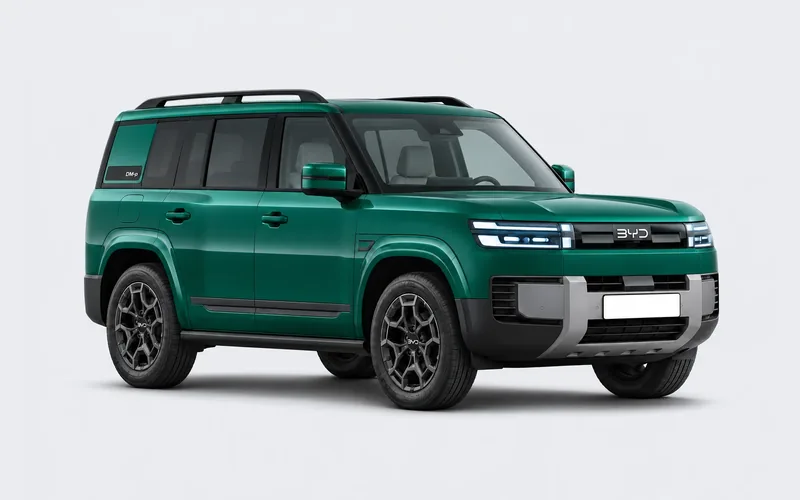
Nothing immediately. BYD hasn’t said anything about selling the Tai 9 outside China. Its smaller sibling, the Tai 7, is sold here as the BYD Ti 7, with a conventional steering column, and UK deliveries are now expected at the end of March.
But this is how Chinese car tech tends to travel: first in China, then in export models a few years later, once the rules allow. If you’re wondering what a mid-priced family SUV might look like in 2030, the Tai 9 is a decent guess. A steering wheel that hides is no longer science fiction. It’s an option box.