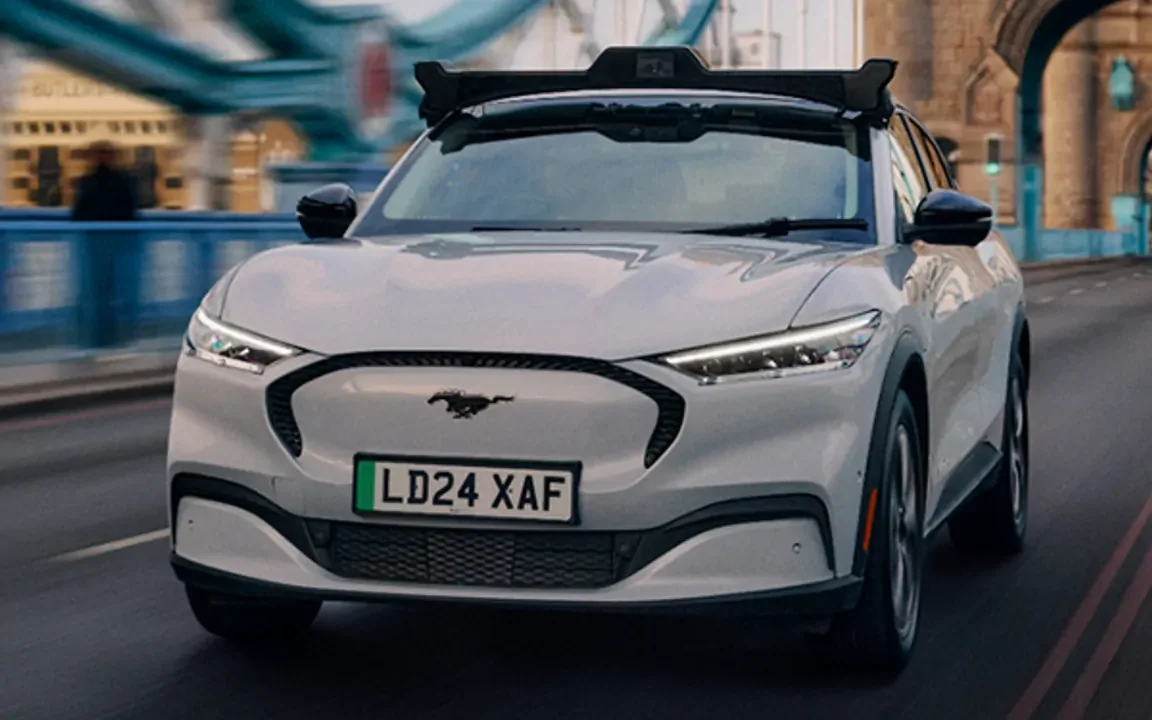
Uber and Wayve, the London-based self-driving software company, have begun the UK’s first public autonomous passenger rides. From 2 September 2026, people booking UberX, Uber Electric or Uber Comfort in London may be matched with an all-electric Ford Mustang Mach-E driven by the Wayve AI Driver.
Every trip has a trained driver on board who holds a Transport for London private hire licence and oversees the journey. This is a supervised service, not a driverless one.
How it works
According to Uber and Just Auto:
- Autonomous rides cost nothing extra; the usual upfront fare is shown in the app.
- A rider matched with a Wayve car can accept it or switch to a conventional ride before it arrives.
- On arrival, riders unlock the car and start the trip in the Uber app. A screen inside shows the planned route and offers 64 languages.
- The service can be booked anywhere in London except the airports.
- Riders can opt in through the app’s settings to improve their chances of being matched. More than 140,000 people had done so by launch.
Neither company has said how many cars are in the fleet, describing it only as a small number that will grow in line with demand, readiness and regulation. No timetable has been given for removing the supervising driver.
Wayve CEO Alex Kendall said: “We’re proud to introduce the Wayve AI Driver to the public for the first time right here in London.” The Transport Secretary, Heidi Alexander, and the Business Secretary, Jonathan Reynolds, both welcomed the launch, Just Auto reports.
Wayve’s approach
Wayve says it has trained its software on London roads since 2018. Its system learns driving behaviour from experience rather than relying on detailed high-definition maps or hand-written rules, and is designed to work across different vehicles and sensor set-ups. The partnership includes Uber investment to put Wayve-driven cars on its network in twelve markets, with London first. A Nissan Leaf using the Wayve AI Driver and Nvidia hardware is planned for Tokyo later in 2026.
The legal backdrop
The government is building the rules under the Automated Vehicles Act 2024. On 23 April 2026 the Department for Transport laid the Automated Vehicles (Permits for Automated Passenger Services) Regulations 2026, which came into force on 15 May. They create a dedicated licensing route for taxi- and private hire-like automated services in England, with permits of up to five years and, in some cases, local authority consent. The government says services must meet stringent safety standards, which will be independently assessed and enforced.
Neither Uber nor Wayve has said whether the London service operates under one of these permits, and the government statement does not say when the first services without a safety driver might be permitted.
What it means for the UK
For Londoners, this is the first chance to ride in a car driven by AI as part of an ordinary Uber booking, at the normal price and with the option to decline. For everyone else, it is a sign that the UK’s framework is starting to produce real services rather than closed trials.
What is not yet known is when the supervising driver will be removed, how large the fleet will become, whether other UK cities will follow, and what safety data will be published. For now, every autonomous Uber in London still has a human ready to take over.