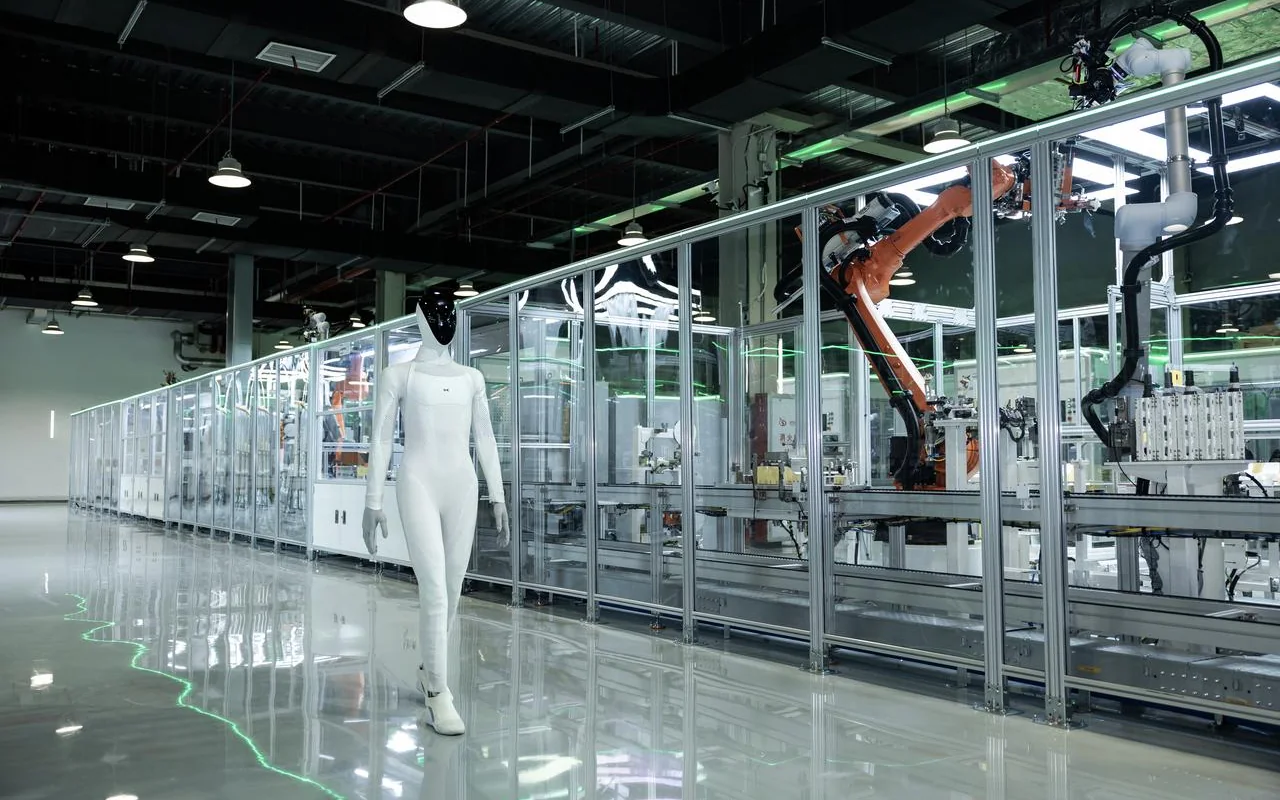
Xpeng has commissioned the production lines for IRON, its humanoid robot, and on 8 September the first unit completed assembly and walked off the line under its own control. The Guangzhou carmaker says the move takes IRON from R&D prototypes to line manufacturing, with mass production scheduled by the end of 2026.
Xpeng describes the lines as the world’s first automated production lines for advanced humanoid robots, with more than 80% of core processes automated. It says they were built to automotive-grade quality standards, drawing on the systems it uses to build its electric cars. Chairman and chief executive He Xiaopeng said the lines had been created from scratch with no precedent to follow.
As CnEVPost points out, opening a line is not the same as mass production. Xpeng has not said where the line is, how many robots it can build or what IRON will cost.
The robot
The production IRON is based on the next-generation design Xpeng showed in November 2025. According to the company it has:
- 76 degrees of freedom in the body and 21 in each hand
- a fully enclosed, flexible lattice body structure intended to balance a human-like look with safety
- three of Xpeng’s own Turing AI chips, rated at up to 2,250 TOPS combined
- Xpeng’s physical AI foundation model running on board, so it can carry out tasks without remote control
Power comes from a dedicated battery that Xpeng says is designed to stop thermal runaway spreading. Xpeng vice-president Gu Jie said in late October that these solid-state batteries had entered small-batch production, CnEVPost reported. Exactly which type of solid-state technology is used is unclear: Xpeng originally spoke of all-solid-state cells, while a later Chinese media report said the production robot would use a semi-solid design.
Timeline and money
The first IRON robots will work in Xpeng’s own stores and campuses. A formal market launch and deliveries in China and overseas are planned for 2027.
The robotics business, Dogotix, also has fresh funding. On 24 August the unit signed agreements for about US$900 million (about £690 million at 7 Nov 2026 rates) of investment, valuing it at about US$6.3 billion (about £4.8 billion) after the round, Caixin Global reported. Caixin Global reported that the investors include IDG Capital, Tencent and Alibaba. Xpeng calls robotics a second growth area alongside cars, expecting a much higher gross margin per unit than on its electric vehicles.
What it means for the UK
Xpeng has not said which overseas markets will get IRON first, and there is no announcement about the UK. For now, this is not something British buyers can order.
The wider point is that Chinese carmakers increasingly see humanoid robots as part of the same business as their cars, sharing chips, AI software, batteries and factory know-how. If that pays off, it could lower costs and speed up development on both sides. But the claims so far are Xpeng’s own, with no independent data on output, reliability or price, and the real test is whether volume production starts on schedule at the end of this year.