Ask a wealthy Chinese family which luxury SUV to buy and, increasingly, the answer isn’t a Mercedes GLS or a BMW X7. It’s a car from a company that, until recently, was best known for phones and telecoms kit.
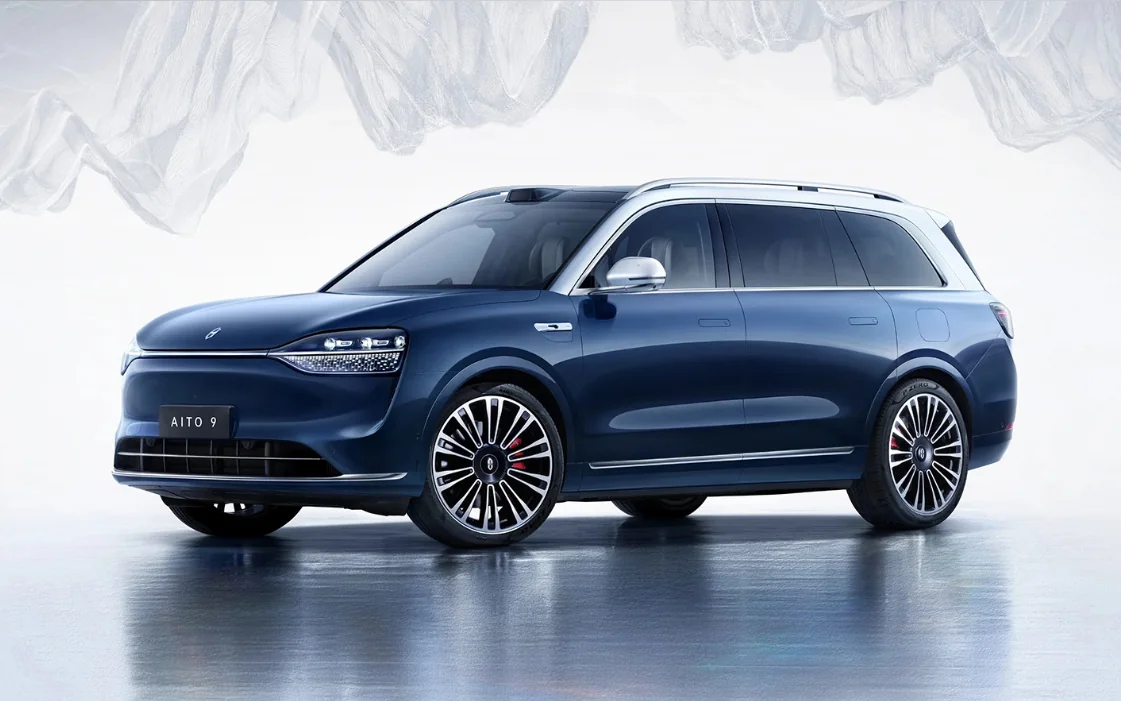
The Aito M9 is built by Seres in Chongqing, but its brains, much of its software and a good deal of its marketing come from Huawei. A Huawei executive says it was the best-selling vehicle of any kind over ¥500,000 (about £57,000) in China for two months running this summer. Independent tallies back up the scale: 9,639 deliveries in July and 10,262 in September, enough to sit among China’s best-selling full-size SUVs at an average transaction price of around ¥600,000. More than 300,000 M9s have been delivered since the first one in late 2023.
This is the first in our series on the Chinese cars that lead their class at home. Few of them are coming here. All of them show where the car is heading.
What you get
The second-generation M9 went on sale in China on 27 May 2026, priced from ¥479,800 to ¥659,800 (about £54,600 to £75,100 at 19 November rates). That’s roughly what a well-equipped large German SUV costs in the UK, before you start ticking options boxes. The M9 has very few boxes left to tick.
| Range-extender | Electric | Ultimate (range-extender) | |
|---|---|---|---|
| Power | 497kW (667hp), two motors | Two motors, 800-volt | 664kW (890hp), three motors |
| Battery and range (CLTC, China test) | Up to 422km electric, 1,405km total | 120kWh, up to 750km | Not stated separately |
| 0–100km/h | Not stated | 4.5 seconds | 3.99 seconds |
| Length | 5,285mm | 5,285mm | 5,402mm |
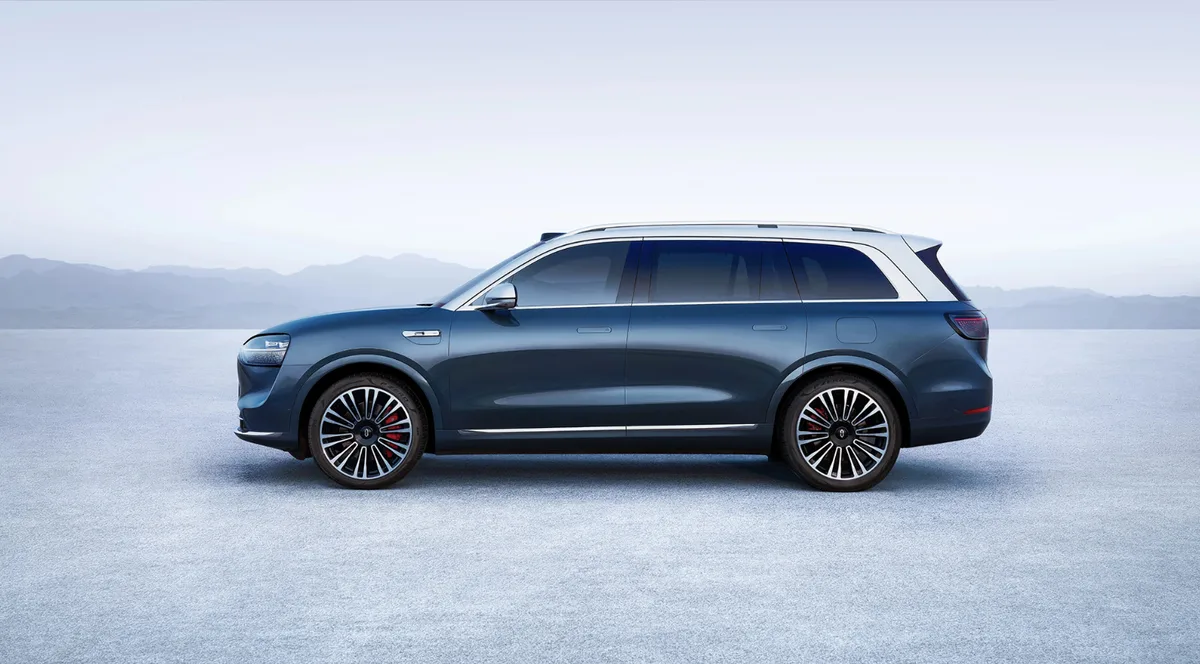 Up to 5.4 metres long and 2 metres wide: big, even by full-size SUV standards. Image: Seres
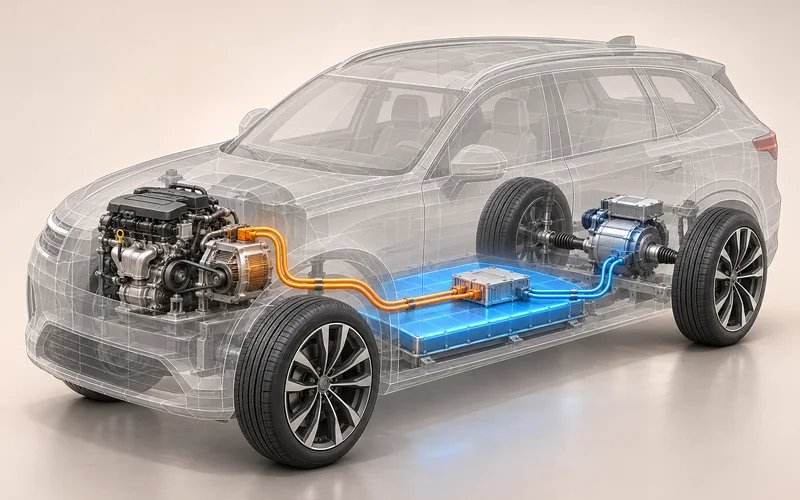
The range-extender versions use a petrol engine purely as a generator; the wheels are always driven electrically. China’s CLTC test is more generous than the UK’s WLTP, so knock a fair chunk off those ranges for British roads and weather.
The clever bits
It sees more than you do. Every M9 carries six lidar sensors, including one 896-line unit that cleans itself, plus five radars, 12 cameras and 12 ultrasonic sensors. That’s around 40 sensors watching the road, run by Huawei’s ADS 5 driver-assistance system, which can navigate from one car park to another. Aito says the hardware is ready for future level 3 upgrades, where the car takes legal responsibility for driving in set conditions.
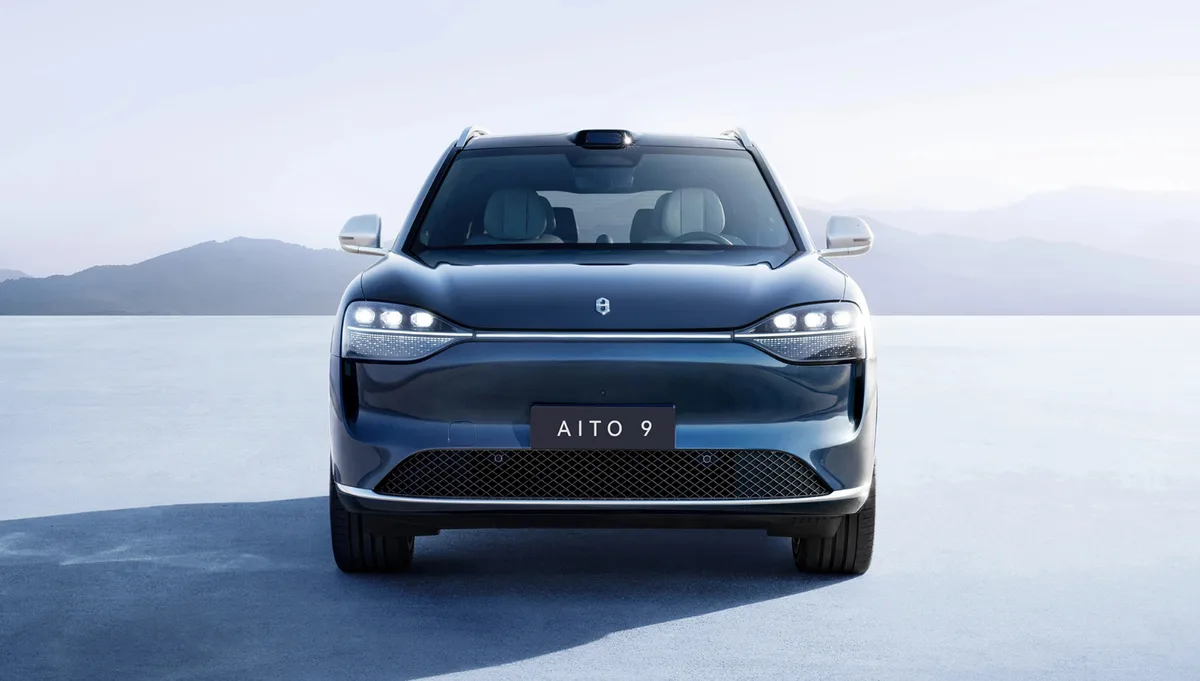 The bump above the windscreen is the main lidar. Image: Seres
It reads the road. All versions have air suspension, adaptive dampers and rear-wheel steering that turns the back wheels by up to 8 degrees, shrinking the turning circle to that of a much smaller car. The flagship Ultimate adds fully active suspension on an 800-volt system: it scans the road ahead and adjusts each wheel independently, so the body stays flat over bumps and through corners.
It’s a living room. Two 17.2-inch screens span the dashboard, a 32-inch projector screen drops down for rear passengers, and a 2,920-watt Huawei sound system fills the cabin. The voice assistant is built on Huawei’s Pangu AI model and DeepSeek. The side pillars use 2,200MPa hot-formed steel, about as strong as steel gets in a car body.
Its crown isn’t permanent. In April, as buyers waited for the new model, sales fell to 3,382, down two-thirds on a year earlier. Being king of a class this competitive is a monthly fight.
Could it come to the UK?
Closer than you might think. Aito’s first sales outside China began in the UAE in February 2026, through Abu Dhabi Motors, where the M9 is called the Aito 9. Then, at the Paris Motor Show in October, Aito announced it will enter Europe in autumn 2027, showing the Aito 9 alongside three smaller SUVs. It is designing the cars for European approval and is aiming for five stars from Euro NCAP.
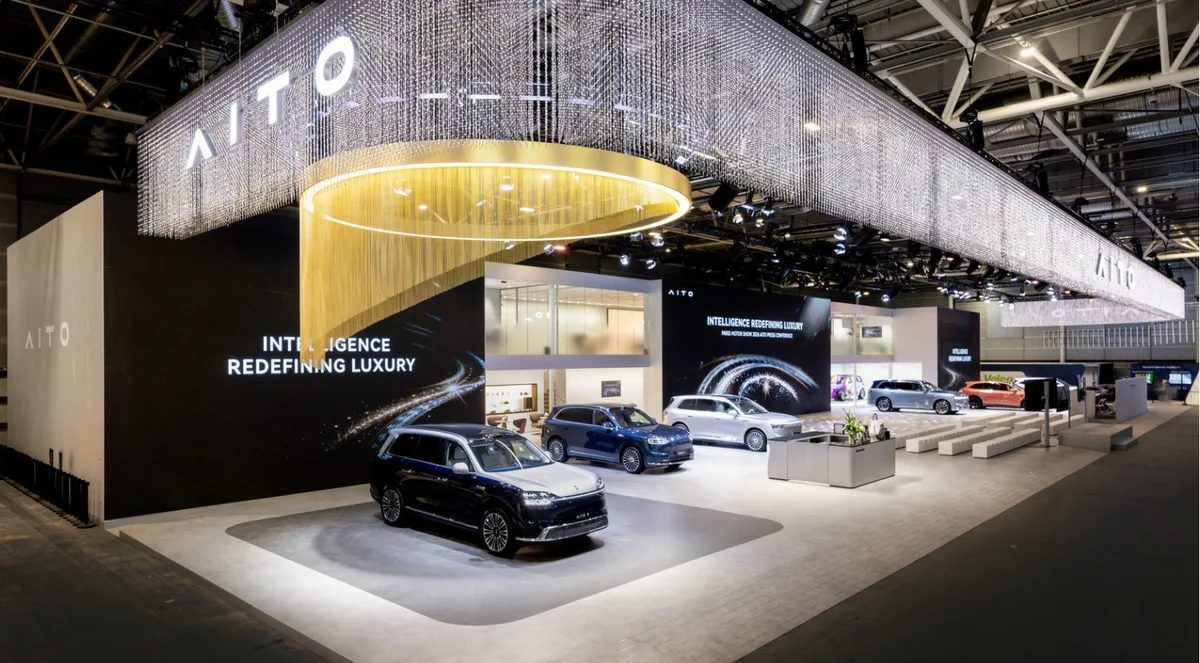 Aito’s stand at the Paris Motor Show, October 2026. Image: Seres
Aito hasn’t said which countries come first, and it hasn’t mentioned the UK. Three hurdles stand out here. A UK car would need right-hand drive, which Aito hasn’t confirmed. Huawei’s name carries political baggage in Britain, which ordered its kit out of 5G networks. And much of the M9’s appeal is driver assistance that UK law doesn’t yet allow to work as it does in China; the Automated Vehicles Act 2024 opens the door to level 3, but the rules are still being written.
Our view
The M9 is the clearest sign yet that the luxury car is being redefined. For a century, it meant leather, wood and a big engine. In China, it now means software, sensors and a suspension that thinks. You can miss the burble of a V8 if you like. Chinese buyers paying £60,000-plus have stopped missing it.
The good news for UK buyers is that this technology doesn’t need Huawei’s badge to get here. The same ideas, from lidar-based driver assistance to predictive suspension, are already arriving in cars from Chinese brands that do sell here. The M9 shows what they’ll be measured against.
What it means for the UK
You can’t buy an Aito M9 in Britain yet, and Aito’s European plans don’t name the UK. But it sets the bar the Chinese luxury SUVs heading our way will be judged against, such as the Yangwang U8 on our watchlist. When a brand tells you its flagship has “advanced driver assistance”, ask how many sensors it carries and what UK law will let it do. The M9’s answer is six lidars and “not yet”.